Solution
Enterprise AI Agent Governance for Regulated Operations
Govern enterprise AI agents with scoped access, runtime policies, human approvals and audit trails across cloud, VPC, air-gapped and hybrid deployments.
In short
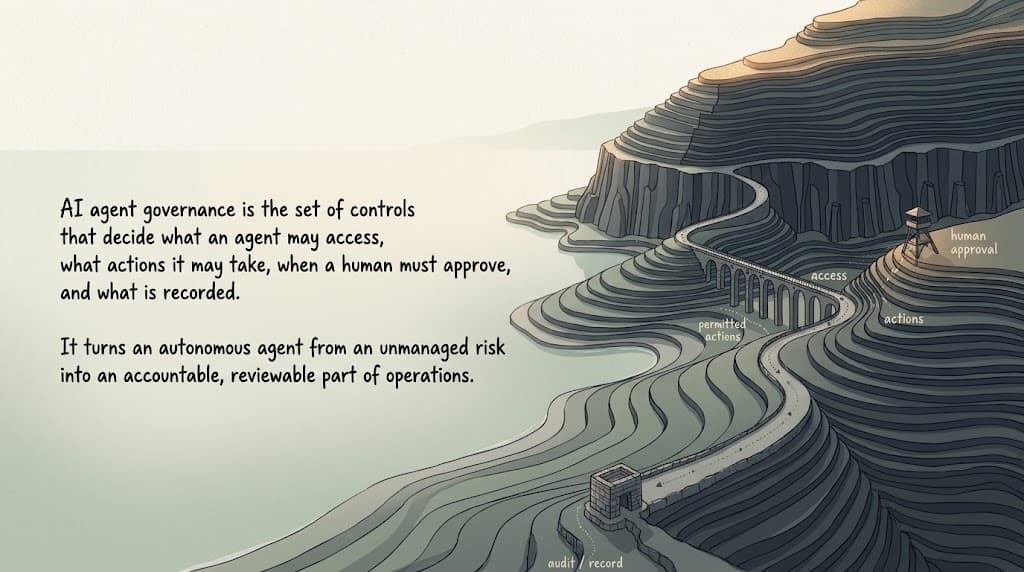
Enterprise AI agent governance is the set of controls that decide what an agent may access, what actions it may take, when a human must approve, and what is recorded. Bitstric governs agent identity, permissions, tool calls, approvals and audit evidence, so autonomous agents stay accountable in regulated operations.
Three layers, one governed AI estate
Bitstric separates discovery and oversight, secure model execution and agent orchestration, so each governance need has a clear home. Select a layer to see what it covers and where it can run.
Aether Console
- role
- Discovery and oversight
- covers
- AI inventory, risk assessment
- evidence
- Audit-trail oversight
- deployment
- Cloud, VPC, hybrid
- entry offer
- AI Risk Discovery Pilot
- pilot
- SGD 3,500, scoped SLA
Aether Console
The governance product. It discovers the AI and agentic systems already running across your organisation, assesses them against six risk pillars and gives reviewers audit-trail oversight.
How it works
Why enterprise AI governance now means agent governance
Enterprise AI governance started with models: data use, bias, validation. Agentic AI changes the risk. An agent reads systems, calls tools and takes actions on its own, so it behaves like a privileged user and a software change at once. Model-level controls alone do not say who the agent acts as, what it may touch or what it did.
Effective AI governance therefore sits in the execution path: agent identity, permissions, runtime policy enforcement, human approvals and audit evidence. A written policy or an AI governance framework only counts when each agent action is checked and recorded. That is the problem Bitstric's platform is built around.
The four controls every agent needs
- Identity and scope: each agent runs with least-privilege credentials and its own access boundary
- Policy enforcement: allowed tools, data and actions are checked at runtime, not after the fact
- Human-in-the-loop: high-impact steps pause for approval, low-risk steps keep running
- Evidence: every step is recorded as an AI audit trail reviewers can replay
Where agent governance usually breaks
Most failures happen at the tool boundary: an agent inherits broad service-account access, calls an unreviewed tool, or acts on retrieved text that contains instructions. Governance has to sit in the execution path, not in a policy document.
AI security and access governance
AI security protects the system from attack. AI governance decides what the system is allowed to do and proves it. Regulated teams need both, and they share the same access controls.
- Per-agent identity instead of shared service accounts
- Permission-aware retrieval, so agents only read what the user may read
- Customer-managed keys and private inference for sensitive workloads
- Rate and spend limits, with a fallback to the manual process
Regulatory mapping for Singapore
Controls are mapped to the themes reviewers raise under the MAS Technology Risk Management Guidelines, the PDPA and the Model AI Governance Framework. Mapping shows where a control produces evidence for a requirement. It is not certification, and it is not legal advice.
- MAS TRM: access control, change management, audit logging, resilience
- PDPA: data minimisation and access to personal data in retrieval
- Model AI Governance Framework: accountability, human oversight, transparency
Why Bitstric
Bitstric combines sovereign deployment, governed agent execution and auditable operations on infrastructure you control. The same team brings engineering and governance experience, so controls are built into the runtime rather than layered on afterwards.
Governance need, control and where it sits in Bitstric
| Governance need | Control | Bitstric layer |
|---|---|---|
| Know which agents exist | Discover AI and agents, assess against six risk pillars | Aether Console |
| Keep models in your boundary | Private inference in VPC, air-gapped or hybrid environments, customer-managed keys | Aether Core |
| Limit what an agent can do | Per-agent identity and allowed tools, checked at runtime | Laminar |
| Require human sign-off | High-impact steps pause for approval | Laminar |
| Prove what happened | Policy traces, replayable runs and audit-trail oversight | Laminar and Aether Console |
Frequently asked questions
For industries shaping the world
Sovereign, auditable AI for sectors where speed, security and scale are non-negotiable.
Legal
Matter data in your boundary, AI use you can supervise, and verification trails for filings.
Learn morePrivate Markets
Issuer due diligence, periodic reporting and model validation for crowdfunding, credit and funds.
Learn moreInformation Technology
Scam-duty evidence, governed network and care agents, and subscriber data kept in your boundary.
Learn more